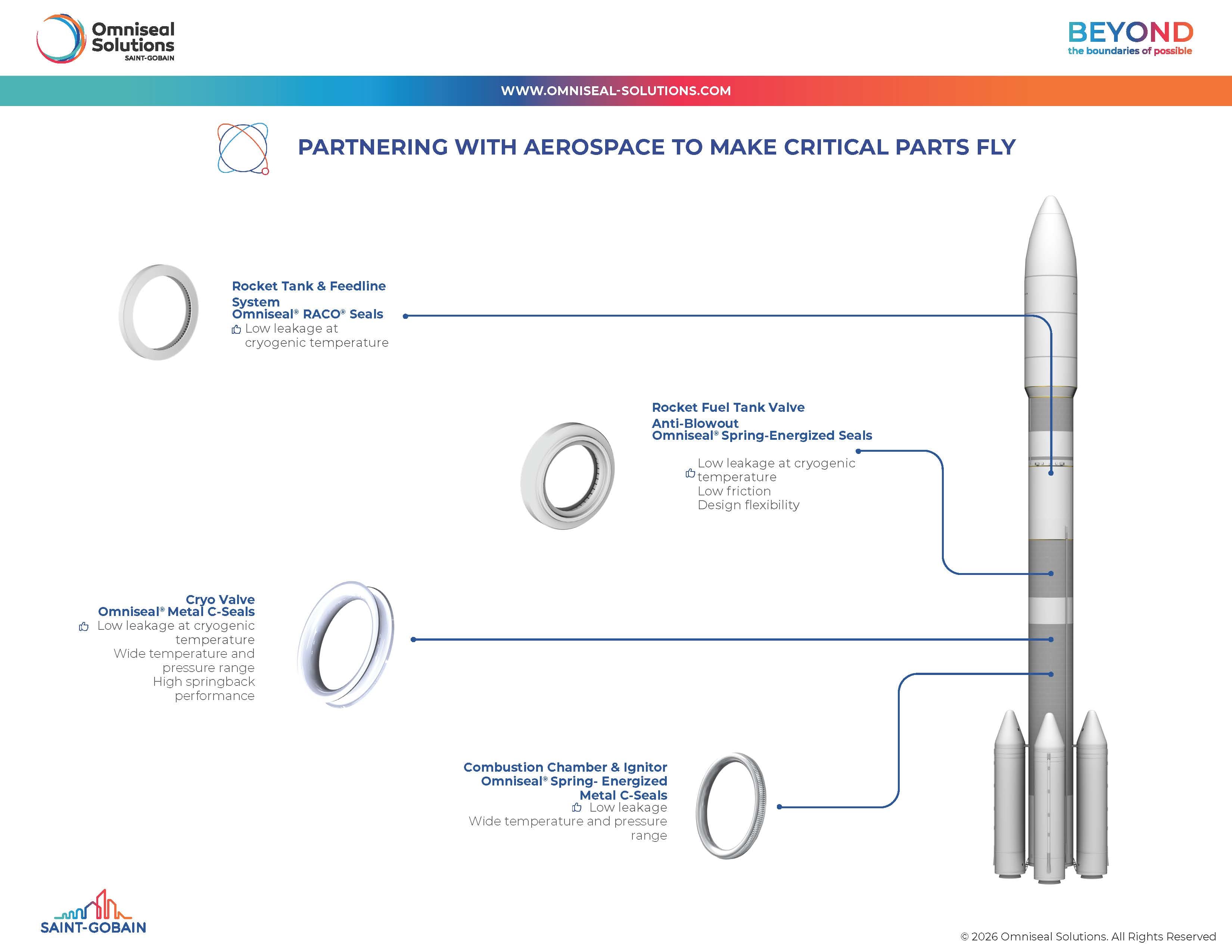
Infographics

Extreme Seals & Materials: Space Launches & Exploration

Cryogenic, Vibration & High Pressure Solutions For Space Industry

Description

Space seals and materials face extreme environments, surviving the vacuum of space and challenging thermal cycles, radiation, and harsh chemicals. You need to use these solutions to protect critical equipment as well as the astronauts. Polymer and metal seals excel in different space environments. Metal seals withstand extreme temperatures and prevent outgassing. Polymer seals prevent leaks in launch vehicles, satellites and life-support systems, compensating for thermal expansion, vibration, and extreme pressure.

Description

Frequently Asked Questions About Our Space Applications

A rocket taking off from a launch pad

Polymer and metal sealing solutions must provide low leak rates to protect capsules for astronauts and keep spacecraft pressurized. This is typically achieved using precision spring-energized seals and custom face seals that compress uniformly between metal or composite components.

Space Launch Vehicle Engine Fluid Control

Outgassing happens when materials release trapped gases or chemicals in the vacuum of space, which can coat sensitive sensor parts or degrade components. Engineers use polymer materials in thermal vacuum chambers to take care of volatile compounds before a launch.

A selection of products from the Meldin® 7000 polyimides aviation group

Space environments undergo severe thermal swings; therefore, seals and material components must have low coefficients of thermal expansion and very high structural stability. Space engineers and technical teams rely on specialty materials such composites and polyimides to manage heat transfer.

A collection of 10 spring-energized seals

Spring-energized seal jackets are typically made from high-performance polymers like PTFE or PEEK, valued for their low and wear friction; excellent chemical resistance; and wide range of temperatures. Depending on if the application is static or dynamic, manufacturers use different spring designs with the springs commonly manufactured from corrosion-resistant metals such as stainless steel, Inconel, or Elgiloy.

A satellite orbiting Earth next to images of Saint Gobain products used in the aerospace industry

Requirements for launch missions and satellite payloads can last from 10 to 30 years without the need for maintenance. Space seals and materials are engineered for continuous creep and wear, offering exceptional longevity and reliable mission-critical performance.

Tags: Mobility Standard Applications